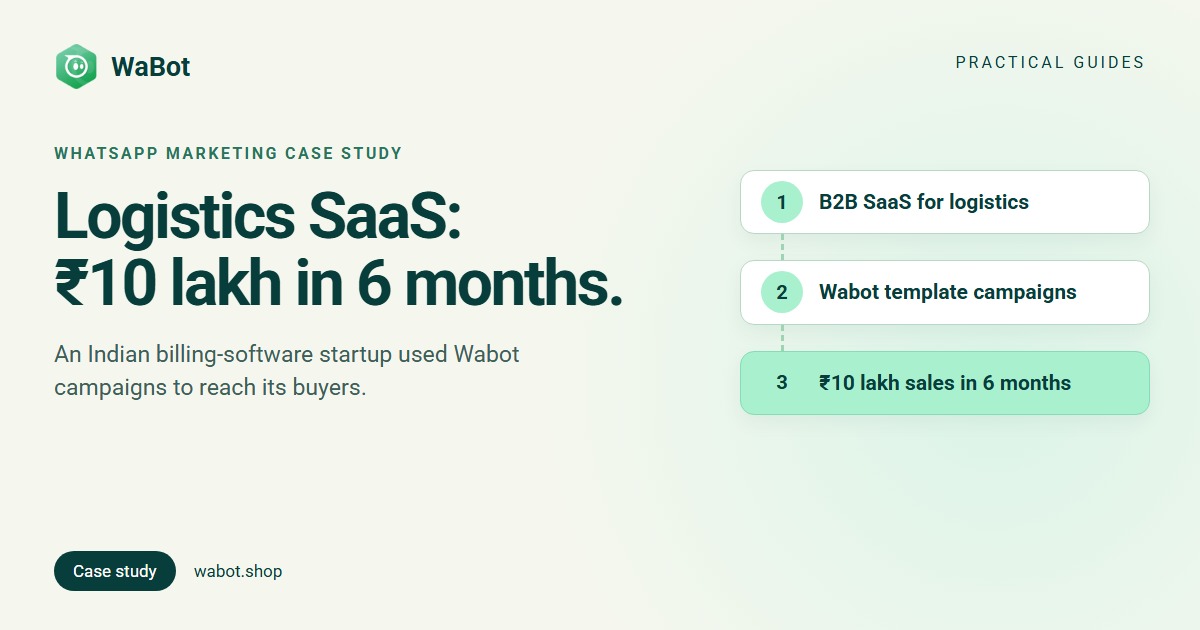
This WhatsApp marketing case study is short on purpose. An Indian startup that sells a billing SaaS application for logistics businesses used Wabot campaigns, WhatsApp template campaigns, to reach its buyers. According to the founder, the company reached ₹10 lakh (₹1 million) in sales within its first 6 months after launch.
The founder asked not to be named, so we share only what we’re allowed to: those facts. The rest of this post is about the method: why WhatsApp suits a B2B software product like this, what Wabot campaigns do, and a playbook you can copy. The playbook and the numbers in it are our illustration, not the company’s data.
The result at a glance
Company: an Indian startup selling a billing SaaS application for logistics businesses (anonymous at the founder’s request).
Channel: Wabot campaigns (WhatsApp template campaigns).
Result: ₹10 lakh (₹1 million) in sales within the first 6 months after launch, as reported by the founder.
Wabot doesn’t see or record its customers’ sales. The figure is the founder’s own report. Campaigns were the channel the company used to reach and convert buyers; the product and the selling were theirs.
The business: billing software for logistics
Logistics billing software, in general, replaces the invoice book and the spreadsheet for firms that move goods. Products in this category typically help with:
- Freight invoices raised per trip, per consignment or per client, with GST.
- Consignment notes or lorry receipts, and matching them to invoices.
- Tracking what each client owes, part payments and overdue bills.
- Trip-level costs such as fuel, tolls and driver advances, so the owner can see what a trip really earned.
The buyers are transporters, fleet owners, courier companies and third-party logistics (3PL) firms. Many are owner-run, and the person who decides on software is often the same person handling dispatch, drivers and collections. That is a general description of the market, not a list of this company’s features or customers.
Why WhatsApp for a B2B SaaS
Email and cold calls are the default for selling software to businesses. For a buyer like a fleet owner, there are three reasons WhatsApp is worth a serious test:
- The buyer isn’t at a desk. An owner who spends the day at a yard, a godown or on calls with drivers reads a short WhatsApp message between jobs. A long email can wait for days.
- The conversation can continue in the same chat. A campaign message with a clear question (“Want a 15-minute demo?”) invites a reply, and the reply opens a normal chat where your team can answer questions, send a video or book the call.
- One channel covers the whole customer life. The same number can send the launch announcement, the demo reminder and, later, the renewal and invoice reminders. Meta treats these as different template categories with different prices: offers are Marketing, reminders about an existing account are usually Utility (Marketing vs Utility vs Authentication).
The condition is consent. Meta’s Business Messaging Policy requires that people have given you their number and agreed to hear from you, and that opt-outs are honoured. Marketing messages need opt-in: a demo request form with a WhatsApp checkbox, a trade-show sign-up sheet or a website chat button all count when the wording is clear (how to collect WhatsApp opt-in). For the wider picture, see the complete WhatsApp marketing guide.
What they used: Wabot campaigns
The company used Wabot’s campaign feature. We can’t share how they set it up, so here is what the feature itself does, in the same terms as our broadcast guide:
- Approved templates, sent as a campaign. A campaign sends one Meta-approved template to a chosen audience, with placeholders filled per contact. Meta says template review can take up to 24 hours.
- Contacts in, tagged. Contacts → Import contacts takes an .xlsx, .xls, .csv or .vcf file through Upload → Map columns → Tags & groups → Review → Import.
- Audience by contacts, groups or tags. Blocked contacts are excluded automatically, and nobody gets the message twice (Campaigns guide).
- Send now or schedule. Launch Options offers Send Now or Schedule for Later with a date and time, and Maximum messages per second controls the sending speed.
- Per-contact reports. Results show sent, delivered, read and failed per contact, with the reason in plain words, for example “Contact stopped marketing messages”.
- Replies land in a shared inbox, so whoever handles sales can pick up the conversation.
The playbook you can copy
This is a playbook, not a record of what the company sent: the campaigns a B2B SaaS selling to logistics firms would typically run, with template wording you can adapt. Fictional names and numbers below are placeholders.
1. Launch announcement to opted-in leads (Marketing)
Hi {{1}}, we built {{2}} for transporters who still raise freight bills by hand. GST invoices, LR matching and pending payments in one place, on your phone. Want a 15-minute demo this week? Reply YES. Reply STOP to opt out.
2. Demo reminder (Utility)
Hi {{1}}, your {{2}} demo is booked for {{3}} at {{4}}. Our team will call you on this number. Reply 1 to confirm or 2 to pick another time.
3. Trial nudge after sign-up (Marketing)
Hi {{1}}, you started your {{2}} trial on {{3}}. A good first step is to raise one real freight invoice. Want us to set up your first client with you on a call? Reply CALL. Reply STOP to opt out.
4. Renewal reminder to a paying customer (Utility)
Hi {{1}}, your {{2}} subscription for {{3}} renews on {{4}}. Amount: ₹{{5}} + GST. Renew here: {{6}}
5. Invoice with payment link (Utility)
Hi {{1}}, invoice {{2}} for ₹{{3}} is ready. Due date: {{4}}. View and pay: {{5}}. Reply here if anything looks wrong.
6. Festive offer to opted-in leads (Marketing)
Hi {{1}}, this Diwali, annual plans of {{2}} at {{3}} off until {{4}}. Reply YES and we'll send the details. Reply STOP to opt out.
More wording to copy, by category: 30+ WhatsApp template examples. If you want a lead’s first few messages to go out automatically over several days after they reply to a keyword, that’s a workflow rather than a campaign: see WhatsApp drip campaign automation.
Order matters. Send the launch message to your warmest opted-in leads first, read the per-contact report, then widen. Meta’s messaging limit starts at 250 unique customers per rolling 24 hours for a new business portfolio and rises with verification and good quality (how to increase it). Bulk-sender apps on the normal WhatsApp app are the fastest way to lose the number (why).
Worked example: what ₹10 lakh could mean
This is an illustration with made-up assumptions, not the company’s data. Their price, plan mix and customer numbers aren’t part of what we can share, so every figure below is invented. The point is to show how to turn a sales target into campaign numbers for your own product.
Say a billing SaaS sells an annual plan at ₹10,000 a year. Then ₹10 lakh in sales means roughly 100 annual subscriptions. Say one in five demos turns into a paying customer: that’s about 500 demos. Say one in eight opted-in leads who receive the launch message books a demo: that’s about 4,000 opted-in leads reached, over several months, not in one send.
And the WhatsApp cost of that illustration? If each of those 4,000 leads got three Marketing templates (launch, trial nudge, festive offer), that’s 12,000 messages × ₹0.8631 = about ₹10,357, plus 18% GST, about ₹12,221 in total, billed by Meta directly. Demo and renewal reminders are Utility at ₹0.115 each plus GST. Rates and more examples: WhatsApp Business API pricing in India.
Change any assumption and the numbers move a lot. Run the same arithmetic with your own price and your own conversion rates from past demos.
What we can and can’t share
The ₹10 lakh figure and the 6-month timeframe come from the founder. Wabot doesn’t record its customers’ sales, so we haven’t verified them.
To protect the founder’s identity, we don’t publish the company’s name, city, product, prices, list size, messages or campaign metrics. Everything in the playbook and the worked example above is our illustration.
How Wabot handles this
- Campaigns without the saved-number rule. Approved templates go to the contacts, groups or tags you pick, whether or not the customer saved your number.
- Send now or schedule, with the sending speed under your control, and a per-contact report when it’s done.
- Know your limit before you send. The inbox shows your current tier (for example “Tier 250” or “Tier 2K”) and a quality dot.
- Replies land in a shared inbox, so the team answers the demo requests a good campaign brings in.
Campaigns are on the Starter plan (₹840/month + GST) and above; the Free plan lets you sign up and connect your number. Workflows, such as keyword-started drip sequences, are on the Base Plan (₹9,240/year + GST). Meta’s per-message charges are billed by Meta directly, with no Wabot markup. Questions before you start? Message us on WhatsApp.
Run your first WhatsApp campaign today
Create your free Wabot account, connect your WhatsApp number to the official API and send an approved template to opted-in leads, with per-contact delivery reports. Connecting a number starts a 15-day Base Plan trial, no card needed.
Frequently asked questions
Did Wabot generate the ₹10 lakh in sales?
No, and we don’t claim it. The founder reports the figure. Wabot campaigns were the channel the company used to reach and convert buyers; the product and the selling were theirs. Wabot doesn’t record its customers’ sales.
Can a B2B software company use WhatsApp marketing?
Yes, if the leads opted in. Send Meta-approved templates as campaigns: Marketing templates for launches, trial nudges and offers, Utility templates for demo, renewal and invoice reminders about an existing account. Every marketing message should carry an opt-out line.
Why can’t you name the company or share its numbers?
The founder asked not to be named. Publishing details such as the city, product or campaign results could identify the company, so we share only the confirmed result and keep everything else private.
How much does a WhatsApp campaign cost in India?
Meta charges per delivered message: ₹0.8631 for Marketing and ₹0.115 for Utility templates, plus 18% GST, billed by Meta directly. On Wabot, campaigns are on the Starter plan (₹840/month + GST) and above.
The bottom line
An Indian logistics billing SaaS used Wabot campaigns as its channel to buyers and, according to the founder, reached ₹10 lakh in sales in its first 6 months. The method behind a result like that is repeatable: collect opt-in, send a clear launch template to warm leads first, remind people about demos and renewals with Utility templates, and read the per-contact report before widening.